Quadruped robots move past the demo era. DaxAI’s heavy-load robotic horse ushers in consumer-facing embodied intelligence.
- 转载
- 浏览
- 2026-08-22 09:47
Quadruped robots move past the demo era. DaxAI’s heavy-load robotic horse ushers in consumer-facing embodied intelligence.
Against the backdrop of the steady implementation of national guidelines including the Opinions on the "AI Plus" Initiative and the Implementation Opinions on the "AI Plus Manufacturing" Special Action, China’s embodied intelligence industry is entering a period of concentrated policy dividends. At the national level, authorities are explicitly promoting the replacement of high-risk, repetitive and high-intensity manual labor with intelligent equipment, and driving the robotics industry to transform from traditional display-oriented devices to practical physical operation equipment with real productivity. This shift is fundamentally upgrading the overall development logic of the sector.
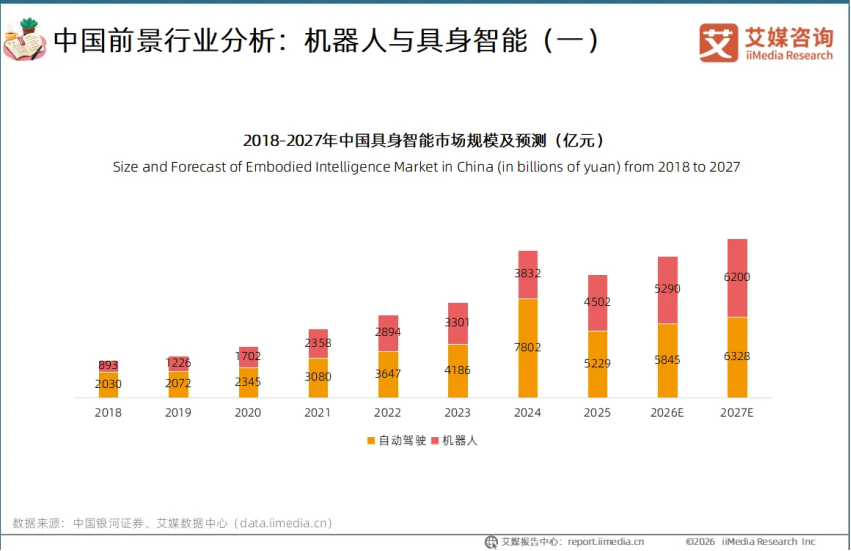
From a macro industry perspective, the embodied intelligence market is in a phase of rapid growth. According to the 2026 Big Data Analysis Report on China’s College Entrance Examination Application and Employment Prospects released by iiMedia Research, the size of China’s embodied intelligence market expanded from 292.3 billion yuan in 2018 to 973.1 billion yuan in 2025, and is projected to reach 1,252.8 billion yuan by 2027. Expanding demand and iterative technological advances are accelerating the industry’s transition from laboratory research to large-scale commercial application.
Investment logic in the capital market has also evolved in tandem. Industry capital continues to flow toward productive robotics tracks with proven monetization and commercialization potential, providing sufficient financial support for the development of the heavy-load quadruped robot segment.
Evolving Industrial Landscape: Rising Technical Barriers and Commercialization Capability as Core Competitive Edge
As downstream applications continue to segment, traditional light-load robots can no longer meet industrial heavy-load requirements, raising the technical barriers of the industry. The focus of competition has shifted from exterior design and basic gait demonstration to comprehensive strengths including in-house development of underlying algorithms, overall machine performance and scenario adaptability.
China’s legged robotics track presents a clear tiered structure. A large number of enterprises are clustered in the light-load home and commercial inspection segments, facing fierce homogeneous competition. A small number of players have entered the blue ocean market of ton-level heavy-load special operations, focusing on heavy-load transportation on complex terrain and high-risk unmanned operations, thus avoiding price-driven involution.
The heavy-load robotic horse track boasts clear growth potential, with robust rigid demand for special operations and insufficient high-quality supply. Nevertheless, it also faces barriers such as component manufacturing processes, cross-scenario adaptation and long customer verification cycles. Compared with general-purpose large language models, embodied world models that enable a closed loop of perception, cognition and action will become a key direction for technological breakthroughs.
Upgrading Demand: From Display Experience to Practical Productivity, Full-Scenario Deployment as Core Benchmark
Procurement and consumer demand in the market have undergone a comprehensive upgrade. Market players no longer only focus on robots’ demonstration effects and exterior experience, but instead prioritize actual operational capability, scenario adaptability and practical value. On the industrial side, key assessment indicators include maximum load capacity, stability on complex terrain and long-duration operational reliability; on the commercial side, attention is paid to batch operation efficiency and scenario compatibility. The overall industry demand is shifting from "display-oriented" to "utility-oriented".
At present, there is a notable structural mismatch between supply and demand in the industry. Most mainstream quadruped robots on the market are light-load display products, lacking ton-level heavy-load operation equipment adapted to industrial and emergency scenarios. Meanwhile, most products are equipped with general-purpose large models, with insufficient generalization ability in physical scenarios and limited autonomous operation capacity. In the long run, iteration of underlying models, dual-track layout for B2B industrial and B2C civilian applications, and industrial chain integration will be the core development themes of the track.
Benchmark Enterprise: DaxAI Robot – Pioneer of the Heavy-Load Embodied Intelligence Track
Founded in May 2025, DaxAI Robot positions itself as a productive embodied intelligence infrastructure enterprise, with the industrial application of system-level embodied world models as its core competitive barrier. Its self-developed DaxBrain-WM (Dualis) Liangyi World Model is an embodied intelligence hub natively designed for the physical world, built from the underlying architecture for robotic productive operations.
The company’s product portfolio covers humanoid robots, wheeled robots and quadruped robotic horses. Among them, its humanoid robots support 24/7 continuous operation, delivering outstanding overall ROI. Its products are applied in scenarios including retail, pharmacies, logistics, cultural tourism, security inspection, and fire rescue.
In July 2026, iiMedia Research granted DaxAI Robot the market status recognition of "Pioneer of the Global Heavy-Load Robotic Horse Industry", based on comparative market research on the public launch timeline of similar products in the global heavy-load robotic horse sector.

Founded in 2007, iiMedia Research has established a full-domain data monitoring system covering global macroeconomics, brand intelligence, consumer insights, wholesale and retail channels, industrial trends, capital allocation and technological innovation. It has built a comprehensive global industry expert database and boasts extensive international industry influence. Since its inception, iiMedia has provided year-round big data consulting services for over 3,800 government and enterprise institutions worldwide. It publishes and customizes more than 2,000 cutting-edge new economy research reports annually. Its data findings, industry insights and research outcomes have been cited over 50 million times by national ministries, local governments at all levels, domestic and overseas listed companies, global mainstream media and authoritative academic publications, covering more than 20 major official languages. It is the largest output provider of core industry perspectives with both credibility and influence in the global new economy sector.
Technological Strength
Technologically, DaxAI Robot’s core competitiveness stems from its full-stack self-developed DaxBrain-WM (Dualis) Liangyi Embodied World Model. The company advocates the design philosophy of "The Body is the Intelligence". Paired with dexterous hands and full-palm tactile sensing components, this design optimizes the robot’s body perception capability, reduces algorithmic computing load, and improves the precision of physical operations.
The model adopts an original Yin-Yang dual-module architecture. The perception-motion module is responsible for fusing multi-dimensional sensing information, constructing 3D scenarios and issuing real-time motion commands. The cognition-scheduling module can connect with mainstream third-party models and features three-level generalization capabilities across objects, tasks and scenarios, which has been commercially deployed in flexible logistics sorting, human-robot interaction and multi-robot collaboration.
Hardware Product Matrix
On the hardware front, the company has built a dual product line matrix covering industrial heavy-load and civilian mobility applications.
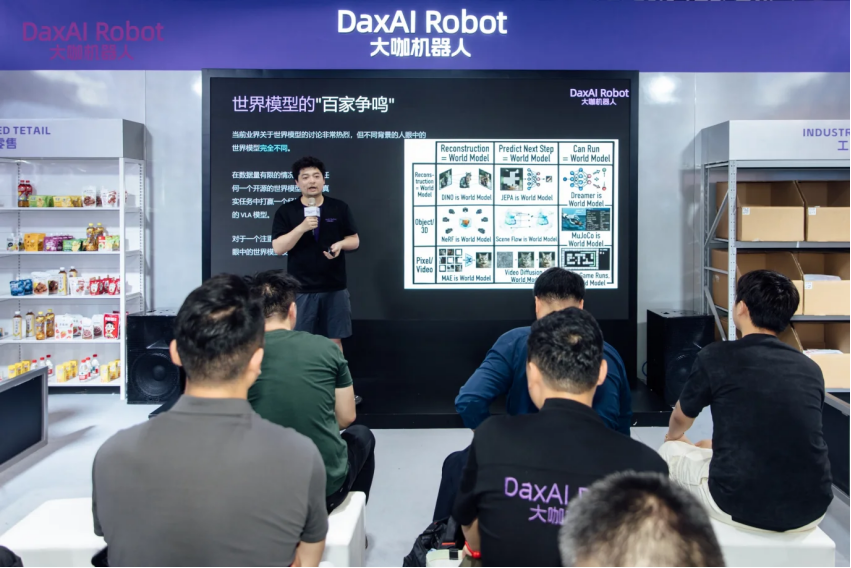
·For industrial use: The Qiji T1000 heavy-load robotic horse is equipped with self-developed high-torque joints, adaptable to complex terrains such as snow, ice, steep slopes and mud. It serves heavy-load operation scenarios including security inspection, fire rescue, engineering construction and intelligent logistics.
·For civilian use: The company has launched two intelligent mount models — the Qiji X1 all-terrain intelligent point-foot robotic horse, and the Qiji XS all-terrain high-speed intelligent wheel-foot robotic horse. The products opened for reservation on JD.com, with reservation volume exceeding 4,000 on the first day, marking the company’s entry into the high-end outdoor mobility track.

Market Strategy
In terms of market strategy, DaxAI Robot adopts a differentiated dual-track layout. For the B2B segment, it focuses on commercial and industrial scenarios such as smart logistics, pharmaceutical transportation, emergency rescue and mountain infrastructure construction, achieving large-scale deployment through strategic partnerships. For the B2C segment, it lays out the high-end outdoor mobility track with its all-terrain intelligent mount products. The dual-track businesses enable mutual empowerment in technology, data and scenarios, effectively avoiding competitive risks of a single track and building a stable and diversified business system.
Long-Term Industry Trends: In-House R&D, Scenario Deployment and Full-Chain Layout Determine Growth Ceiling
Based on analysis of industrial policies, market demand and competitive landscape, the heavy-load quadruped robot track will continue to see quality improvement and industry reshuffling in the future, with three definitive development trends.
First, native embodied world models and core independent hardware technologies will become core barriers for enterprises, and assembly-oriented manufacturers without in-house R&D capabilities will be gradually phased out of the market. Second, proven on-site deployment cases and large-scale delivery capacity are key credentials for enterprises to seize the B2B market, and players with insufficient deployment capability will struggle to achieve long-term growth. Third, a full-scenario dual-track layout covering both B2B and B2C segments can effectively avoid homogeneous involution, and multi-category layout can continuously tap into incremental opportunities in niche markets.
Going forward, enterprises with full-chain capabilities including underlying algorithm R&D, complete hardware development, full-scenario deployment and large-scale delivery will continue to benefit from industry growth.
本文地址:http://www.quanqiucaijing.com/qqsy/2226.html
 卡萨帝20周年:发布藏家套系,定义高奢生活新方式行业1
 光伏概念股走高背后,硅料价格已连续多周企稳财经2
 集体怒喷销量周榜,中国车企卷不动了财经3
- 财经打造丰富AI生态体验 三星Galaxy Z Fold6|Z Flip6及生态新品中国发布
- 财经告别免费时代,闲鱼着急赚钱?
- 财经自建房,可能撑起下一个地产周期
- 行业卡萨帝“科技长城”案例获年度大奖
- 行业高端家电市场洞察:一份榜单,看懂消费升级路径
- 财经硅谷时尚Allbirds失宠,在华独家运营权交给百丽集团
- 行业深耕磨边智造,赋能产业升级——广东金玻“智能装备”引领玻璃加工行业新变革
- 行业双店销额均超百万!卡萨帝城市体验中心落地苏州、邯郸
- 财经人工智能高质量发展研讨会在易信科技隆重召开
- 行业卡萨帝20周年:发布藏家套系,定义高奢生活新方式
- 财经2024“汾酒试点”大曲专题项目的研究基础
- 财经海底捞,困在翻台率里